
Whats Really Yours to Control and How to Find Peace in the Rest
March 6, 2026 · By Farah AlHomoud
So much of life is outside of our control. Other people’s choices. The past. Timing. Unexpected change. These are things that happen around us, beyond what we can influence. And yet, we often try to hold on tightly to them. We try to control what isn’t ours to hold, and it leaves us feeling anxious, frustrated, or powerless.
But there is another way. We can gently shift our focus to what is within our control. We can choose how we respond to situations. We can take care of ourselves, set boundaries, speak and treat others with intention, notice our self-talk, process our emotions, consider the meaning we give the events in our lives, and manage the expectations we place on ourselves and others.
Focusing on what we can control does not mean denying the pain we’ve experienced. It does not mean minimizing what happened to us. It means we choose how we show up for ourselves now. It means taking care of ourselves moving forward.
We are not responsible for the harm others have caused us. We are responsible for how we care for ourselves. We are responsible for the choices we make about our energy, our boundaries, and our responses.
Life isn’t about controlling everything. It’s about recognizing what is truly ours to influence and giving ourselves permission to let go of the rest. This doesn’t make the world perfect, but it gives us a calm, steady foundation we can return to whenever life feels unpredictable.
Shifting Your Focus from What You Can’t Control to What You Can
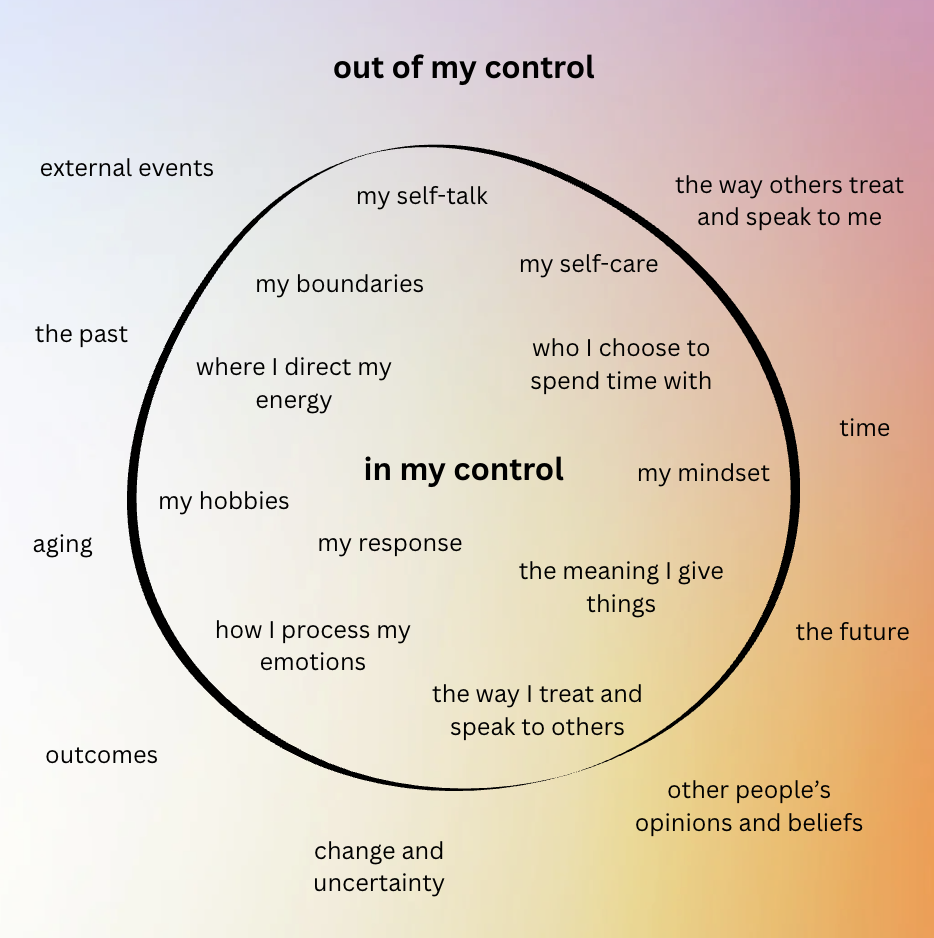
One of the most effective ways to practice this is with a visual exercise. Grab a piece of paper and draw a big circle. Inside the circle, write down everything you can control. This might include your self-talk, your boundaries, the way you speak to and treat others, the meaning you give experiences, and your expectations. On the outside of the circle, write what you cannot control. This might include other people’s choices, the past, timing, unexpected change, and outcomes.
Seeing it laid out visually like this can be really powerful. It shows at a glance what is yours to influence and what isn’t. You can revisit it whenever life feels overwhelming. It helps gently redirect your focus back to what’s in your control instead of spinning in worry or frustration.
Here is an example of what this exercise might look like:
Once you’ve created your circle, you can take the exercise a step further:
1. Check in with your self-talk
Notice thoughts that pull you toward things outside your control. Ask yourself if this is something you can influence. If not, redirect your focus to what you can do.
2. Set small, intentional actions
For each thing in your control, choose one small action today. For example:
• Set a boundary you’ve been avoiding
• Spend ten minutes on self-care
• Write down the meaning you choose to give an event in your life
3. Journaling prompts
• What is mine to control in this situation
• What is not mine to control
• How can I respond today in a way that aligns with my values and self-care
4. Daily reflection
At the end of the day, note one moment where you focused on what was in your control. Celebrate yourself for making choices that support your well-being. Over time, this practice builds a sense of calm and groundedness, even when life feels unpredictable.
Focusing on what’s in our control does not remove life’s challenges. It simply gives us a place to stand when everything around us feels uncertain. When we care for ourselves, show up intentionally, manage our expectations, and notice the meaning we give to experiences, we reclaim a quiet center we can return to again and again.
I offer online counselling for women in BC. You can learn more about my approach and experience as a Registered Clinical Counsellor on my About page. When you feel ready, you can book a consultation to begin working together in a safe, supportive space.